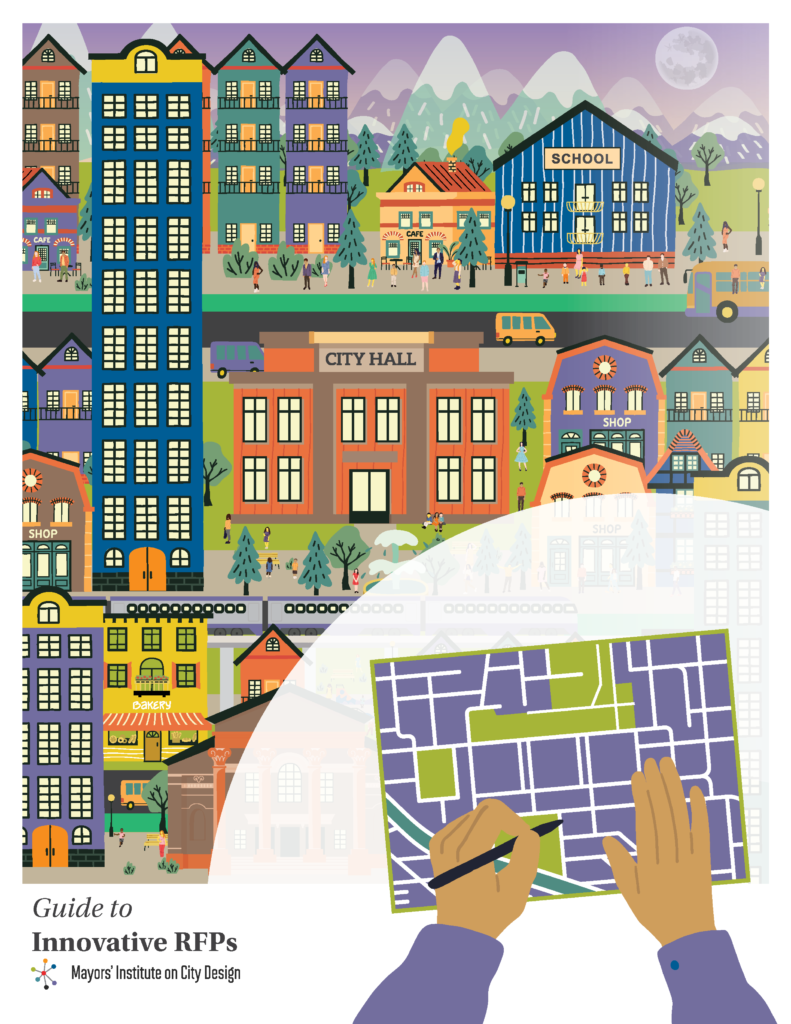
Guide to
Innovative RFPs
Putting the Principles for City Design Leadership into action
OVERVIEW
The Request for Proposals (RFP) is one of the most consequential tools a city has to translate values into real-world outcomes, guiding how resources are awarded, services are procured, and partners are selected. Informed by a national scan of successful RFPs, the Guide to Innovative RFPs offers a roadmap for designing and delivering more impactful design and development projects.

Explore the Guide
01 | RFPs and the Principles for City Design Leadership
MICD’s five Principles for City Design Leadership can help guide the development of value-based RFPs that create maximum impact for your community.
02 | Elements of Good RFPs
Explore an illustrative timeline with key milestones for your engagement and RFP development process.
03 | Put it together!
Investing in creatively approaching your RFPs will result in projects that reflect your community’s values, priorities, and desired outcomes.
Key Takeaways
- Takeaway 1
- Takeaway 2
- Takeaway 3
Explore referenced projects
- Hollice T. Williams Park, Pensacola, FL: After an overhauled community engagement process, this new park design is experiential, emphasizes equity and justice, and includes innovative stormwater infrastructure and landscape architecture practices. Read more
- Invest South/West, Chicago, IL: Guided by the people who live and work within each community in Chicago, the INVEST South/West strategy has paved way for more than a dozen major mixed-use projects, comprehensive public realm enhancements, new cultural installations, and a pipeline of financial grants for small businesses and emerging developers that will resonate for generations to come. Read more
- Brush Park, Detroit, MI: Featuring over 400 residential units distributed amongst approximately 20 buildings, the Brush Park RFP made use of its proximity to Downtown Detroit and Midtown, major sports stadiums, parks and entertainment, as well as the city’s Central Business District to maximize density and bring vacant parcels of land back online. Read more
- Boston Design Vision, Boston, MA: The City of Boston Planning Department’s Urban Design Division engaged with hundreds of Bostonians about what they love most about their neighborhoods to better understand what “good design” means to the people who call Boston home. Read more
- NW Rubber Site, McMinniville, OR: After purchasing a 3.6-acre industrial site in the NE Gateway District, the city sought a development partner to build a mixed-use commercial and residential development to revitalize this city center industrial neighborhood into a vibrant commercial and residential district. Read more
- Englewood Agro District, Chicago, IL: This nearly 2-mile rails-to-trails project in a historically underinvested community is exploring a Public-Common partnership (PCP), as an economic development strategy in which wealth created is shared by the community, rather than solely with the private sector or government. Read more
Principles of City Design Leadership
Lead
with design
Design
for meaningful change across your city
01
Lead
to improve people's lives
Design
to connect communities
02
Lead
for economic opportunity
Design
to create and capture value
03
Lead
to foster health + resiliency
Design
to create a beautiful city
04
Lead
collaboratively
Design
for all
05
let’s talk
We are here to help.
Our team is happy to help you strategize ways to utilize these resources. Contact our office to set up a time to discuss.
MICD is a leadership initiative of the National Endowment for the Arts in partnership with the United States Conference of Mayors. Since 1986, MICD has helped transform communities through design by preparing mayors to be the chief urban designers of their cities.
Join our Mailing List
Sign up for our newsletter to stay up-to-date on the latest resources.